
The Origins of Loosh: Who Coined It and How It Comes into Our Reality
Every generation tries to explain the same ancient feeling: that human suffering is not simply a byproduct of life - but a substance that feeds something beyond our perception. Some call it spiritual energy. Some call it fear harvesting. Robert Monroe, the man who unintentionally opened a door he couldn't close, called it Loosh.
To understand Loosh you have to understand him. And then you have to look at how his idea threads itself through religion, mythology, physics and the deepest parts of human psychology.
Who Was Robert Monroe? A Reasonable Man Slipping away to Insanity gradually
Robert A. Monroe was not a mystic. Not a guru. Not someone chasing spiritual highs. He was a radio executive in the 1950s - a man obsessed with sound, frequencies and the mind's reaction to them. His initial research had nothing to do with other dimensions or "entities". He simply wanted to explore how audio waves could influence learning and creativity.
Then something unexpected happened. He started going out of his body. Not metaphorically. Not in dreams. Monroe described conscious, descriptive episodes where he floated above his bed, saw his own motionless body, drifted through walls and entered landscapes that seemed solid and real. He thought he was going insane. He went to doctors, psychiatrists and got his brain scanned due to tumors. But nothing was wrong.
Monroe, the rational businessman, was forced to accept the irrational: he was experiencing OBEs - out-of-body events - regularly and involuntarily. These experiences plunged him into worlds that he had zero interest in exploring, until something started watching him back.
Where the Concept of Loosh Appears
Monroe documented everything. Not as a poet or a mystic but like a man writing a field report. And somewhere in this strange diary of non-physical travel he encountered something disturbing: a system, a farm where emotional energy produced by living organisms was treated as a resource. In one of his earliest manuscripts he has outlined a situation:
There is some Creator-like being. This being "plants" life in different environments. Life grows, evolves and inevitably experiences intense emotions. These emotions generate a substance Monroe called Loosh. Higher-level beings collect this energy for sustenance or function. It sounds insane - until you realize he wrote about it in the 1950s, long before such ideas entered pop culture.

Why Emotional Energy? Why Fear and Pain?
Monroe did not posit that Loosh was only negative. He proposed all forms of emotions to produce it, love, joy, creativity. But he saw something disturbing: pain, fear and suffering gave out very more powerful spikes. He made it analogous to lightning storms, but of emotion. He didn't even want to publish it at first. He felt the concept was too strange, too metaphorical, too dangerous. But eventually parts of these writings appeared in his second book Far Journeys. That book became the genesis of the modern Loosh idea.
How Does Loosh Work in Our Reality?
From the perspective of "higher beings" he encountered, emotional intensity seemed to matter more than moral value. And fear is the most intense emotion humans generate. Then suppose you were a being who could tap energy and you did not care about ethical considerations, then you would come up with a system that maximizes:
- conflict
- chaos
- emotional volatility
- the everlasting process of despair and gain.
Sound familiar?
It's the valley of tears according to religion. It's what psychology refers to as trauma response. To Monroe, it was Loosh production. The names differ, the mechanism doesn't. Does Loosh exist as a Metaphor or a Real Place? This is the question that divides the discussion into two camps.
Camp 1: Loosh as Metaphor
For many researchers, Loosh is a symbolic way of describing:
- human emotional output
- empathic fields
- behavioral patterns
- psychological energy exchanges
- the way groups influence individuals
In this view "harvesting" simply means we're manipulated by media, politics and institutions that profit from fear.
Fear = Control. Control = Power. Power = Energy.
Camp 2: Loosh as Literal Non-Physical Energy
Others take Monroe at his word. They believe:
- consciousness exists independently of the brain
- emotional energy is detectable in non-physical dimensions
- non-human intelligences exist
- they benefit from high-intensity emotional output
This isn't as fringe as it sounds.
Quantum theorists explore observer effects in consciousness. The "simulation hypothesis" suggests reality is constructed. Ancient traditions speak of gods, archons, demons, egregores - all feeding on devotion, fear or worship. Different cultures, different eras, same theme: Something feeds on what humans feel.
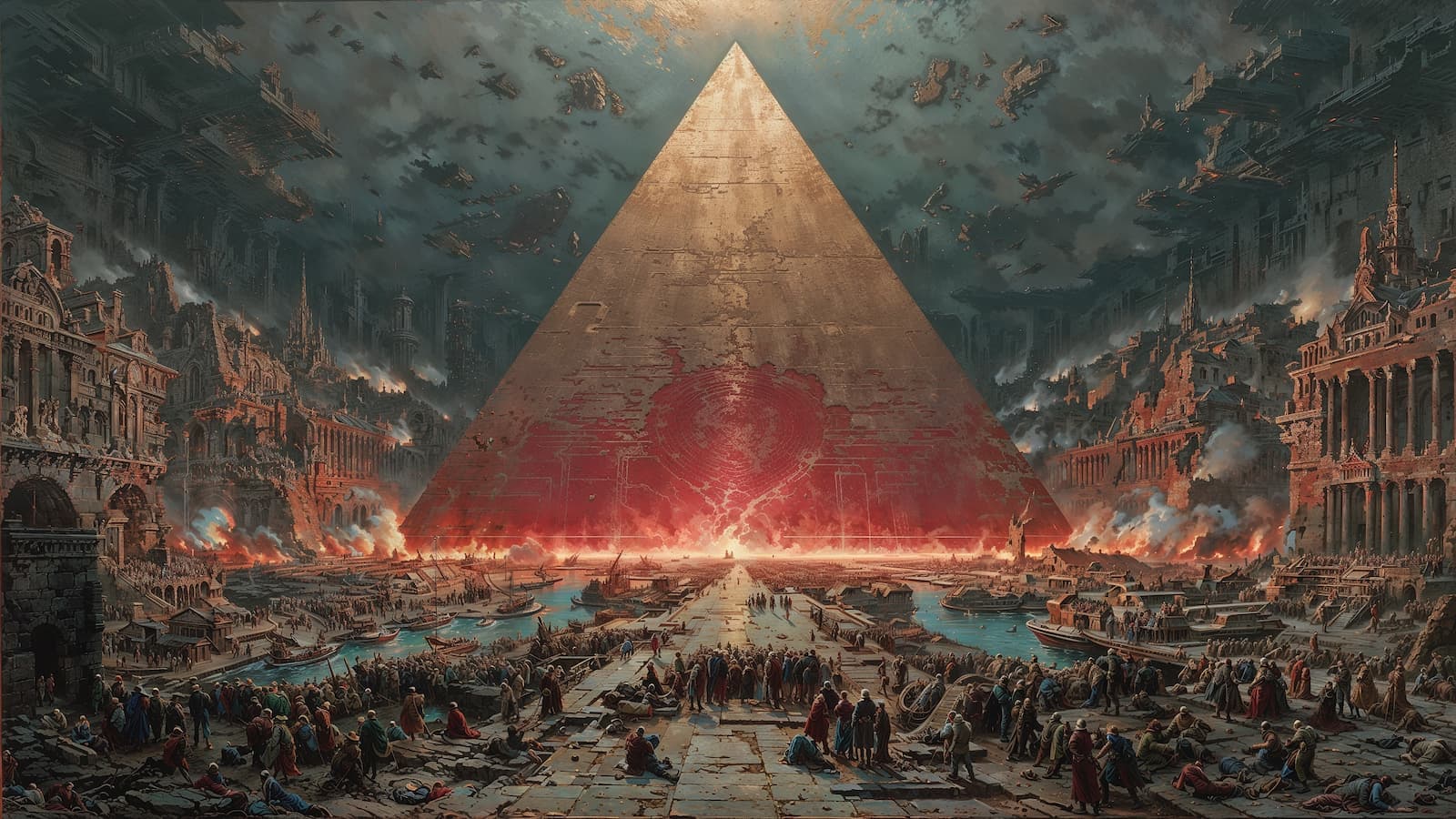
Religions Hint at Loosh Without Naming It
Consider this.
Christianity: Human suffering is meaningful and "offered up" to God.
Cosmology of Aztecs: The gods needed emotional-energetic nourishment provided through ritual and sacrifice.
Buddhism: Life is suffering and the cycle continues until one escapes the system.
Gnosticism: The world was created not by the true divine source but by a flawed demiurge who traps souls.
Islamic theology: Jinn are emotional predators which manipulate human behavior.
Hinduism: Lila - the divine play - where human experiences provide something meaningful to higher dimensions.
Each religion suggests that human emotion is important, other beings than ourselves can be responsive to it, and our lives are not a happenstance. Monroe simply stripped the poetry from it and made it clinical:
Emotion = Energy. Energy = Loosh. Loosh = Harvested.
The Loosh theory mirrors modern science more than you think
Strangely, Monroe's idea aligns with:
-
Entropy Theory in Physics. In our universe everything tends to break down and mix together over time if no energy is spent to keep it in order. Life is basically an attempt to hold on to order in a chaotic world and it does this through constant struggle and change. In moments of intense stress and suffering, a system goes through especially sharp and powerful energy shifts.
-
Observer Effect. We don't experience the world directly but through our consciousness, so for us reality exists the way we perceive it. Emotions and feelings change how the brain works - its electrical activity and fields around it - and that changes how we live through what happens.
-
Ecosystems and Predators. In nature almost every creature is prey for someone else: some live at the expense of others and this is what keeps the whole cycle of life going. It would be strange to assume that on some "invisible" level these principles suddenly disappear and there is no similar kind of exchange or feeding on someone else.
-
Neural Evolution. Our brain is built so that it reacts more strongly to bad things than to good ones: threats, danger and pain stick in memory better than pleasant moments. This looks less like a random quirk and more like a system that was specifically tuned so that fear and negativity are the strongest survival signals.
-
Simulation Theory. There's a hypothesis that our reality might be something like a complex simulation. If that's the case our emotions and experiences might be not only "pure experience" but also data, a resource or even fuel for some external system that's running this game.
So How Does Loosh Enter Our Reality
Monroe never gave a strict mechanism but his writings imply:
- Loosh is produced by emotion.
- Emotion is triggered by life challenges
- Life challenges are embedded into the design
- The "output" is collected by non-physical intelligences
- These intelligences influence events to increase harvest cycles
In his view, Earth itself was engineered as a production environment. Not a prison. Not a hell. Not a school. A garden. And humans? The crops...
Why the Concept Is Both Terrifying and Liberating
The idea that something benefits from our suffering is unsettling. But if suffering is "designed", then it also means:
- pain isn't your fault
- trauma isn't weakness
- fear is not failure
- you are part of a larger energetic system
- and you can step out of the cycle by becoming aware of it
Monroe believed awareness reduces energy leakage. Consciousness dissolves the "harvesting" effect. In other words: once you understand the farm you stop being livestock.