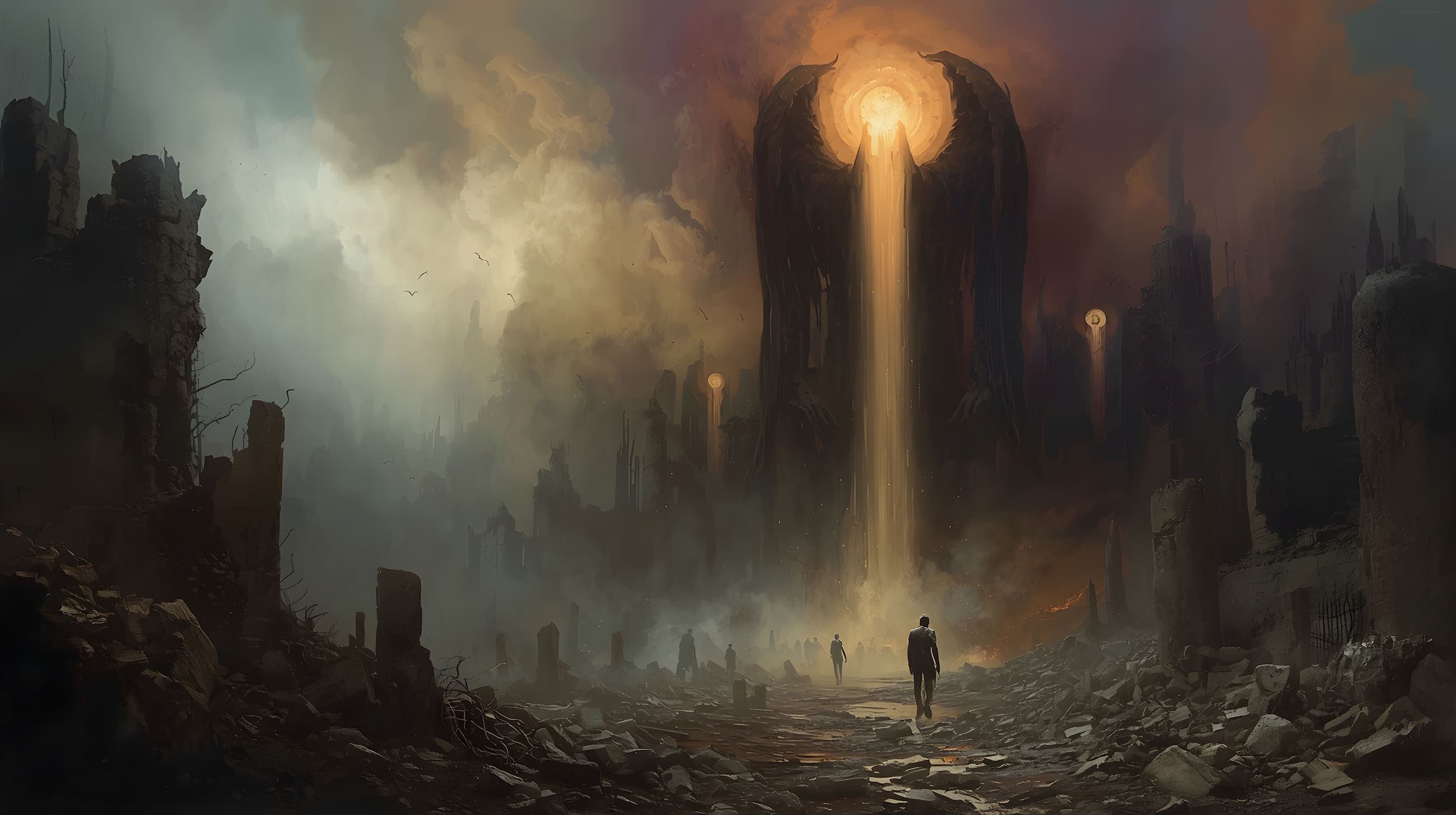
🜃 What _
The word itself comes from Robert Monroe, an American businessman who in the 1950s began having spontaneous out-of-body experiences he could neither explain nor stop. He documented them obsessively over several decades, and in 1971 published the 1st of 3 books that would eventually make him one of the most influential figures in consciousness research. Monroe wasn't a mystic by temperament. He was precise, skeptical of his own experience and more interested in structuring what he found rather than giving it a meaning that suited him.
What he found, during one particular journey outside his body, disturbed him enough that he spent years trying to understand it before he wrote about it at all.
He discovered that human beings produce something. An energy or emanation generated specifically through love, grief, fear, pleasure, longing, the whole texture of a lived life. Non-physical intelligences, he found, were aware of this. Some of them seem to depend on it. Monroe gave this substance a name drawn from no prior tradition, a word that carried no baggage from religion or philosophy: Loosh.
But It's not that consciousness simply releases excess energy. Everything is much more alarming. Monroe realized: perhaps the Earth itself and our lives are a specially designed farm. Suffering, impermanence, and intense emotions aren't bugs in the universe. They're cogs in a system designed to produce what feeds something invisible.
He was careful about how he framed this. He didn't say humans were victims. He didn't say the entities harvesting loosh were evil in any simple sense. He remained a researcher to the end, describing what he found rather than condemning it. But the structure he described was not neutral, and he knew it.
What makes the concept of loosh interesting beyond Monroe's own account is that he appears to have arrived at something that other traditions had been circling from entirely different directions for centuries. The Gnostics of the second century described a false creator and subordinate entities ( the archons ) who maintained the material world as a kind of trap for divine sparks of awareness. They were not interested in human bodies. They were interested in the light inside them.
Carlos Castaneda's teacher don Juan described predatory beings he called the flyers, inorganic entities who had colonised human consciousness so thoroughly that the anxious, self-referential chatter running behind most people's thoughts wasn't originally human at all but something installed, something that served the harvesters rather than the host. In Hebrew mysticism, the same current runs through the concept of gavvah - a swelling of self that feeds something other than the self.
None of these traditions were in conversation with each other. Monroe had not read the Nag Hammadi texts when he named loosh. Don Juan's lineage predates Castaneda's books by generations. Gurdjieff drew from sources he never fully disclosed. The convergence isn't the result of one tradition borrowing from another. It's the result of different people, using different methods, arriving at the same structure from different sides.
Why suffering specifically
Monroe observed that strong negative emotions produce the most concentrated Loosh. The Gnostics say the same: the archion system is tuned to produce a specific type of energy. Now look at humans. Our nervous system is overly tuned to detect threats - far more than is necessary for survival. Internal dialogue constantly generates anxiety, social fears, and catastrophes that haven't yet happened. All of this perfectly produces precisely the emotional intensity that, according to Monroe, is the most valuable harvest.
Whether this is a flaw in creation or a feature of it's one of the oldest theological questions. The loosh framework offers a specific answer that most theologies have avoided: it's a feature, and it serves something that's not us.
What this project is
This is an attempt to map this structure. Not to prove it because it's scientifically unprovable. But to take the hypothesis seriously and trace its development through philosophy, mythology, neuroscience, and other, stranger frontiers of consciousness research. To see what it sheds on the shape of human experience.
The word loosh is a starting point. A strange, unattractive, made-up word for something that may be the most important thing anyone has ever noticed.


Remain in range
The Loosh Project delivers essays on consciousness, energetic predation and the hidden architecture of reality.
No algorithms. No noise. Signal reaches you directly.
No extraction · Unsubscribe anytime