Child of Chaos: The Gnostic Mystery of the First Archon - Sabaoth
This text is an artistic-philosophical essay drawing from Gnostic texts (the Apocryphon of John), the metaphysical hypotheses of Loosh and Gavvah, and religious sources. The author doesn't claim scientific proof. This is an attempt to look at familiar texts through an alternative metaphysical lens - asking not "what is sacred", but "who benefits"?
Born in Darkness
Gnostic texts discovered in 1945 at Nag Hammadi preserve a different creation story - one that, according to the apocrypha, Jesus revealed to his closest disciples in secret. This story tells of how the material world was created not by the All-Good God, but by a lower being, born of error. In the Apocryphon of John (The Secret Book of John), Chapter 3: "The Fall of Sophia" recounts the birth of the First Archon:
And the Sophia of the Epinoia, being an aeon, conceived a thought from herself and the conception of the invisible Spirit and foreknowledge. She wanted to bring forth a likeness out of herself without the consent of the Spirit, - he had not approved - and without her consort, and without his consideration. And though the person of her maleness had not approved, and she had not found her agreement, and she had thought without the consent of the Spirit and the knowledge of her agreement, (yet) she brought forth. And because of the invincible power which is in her, her thought did not remain idle, and something came out of her which was imperfect and different from her appearance, because she had created it without her consort. And it was dissimilar to the likeness of its mother, for it has another form.
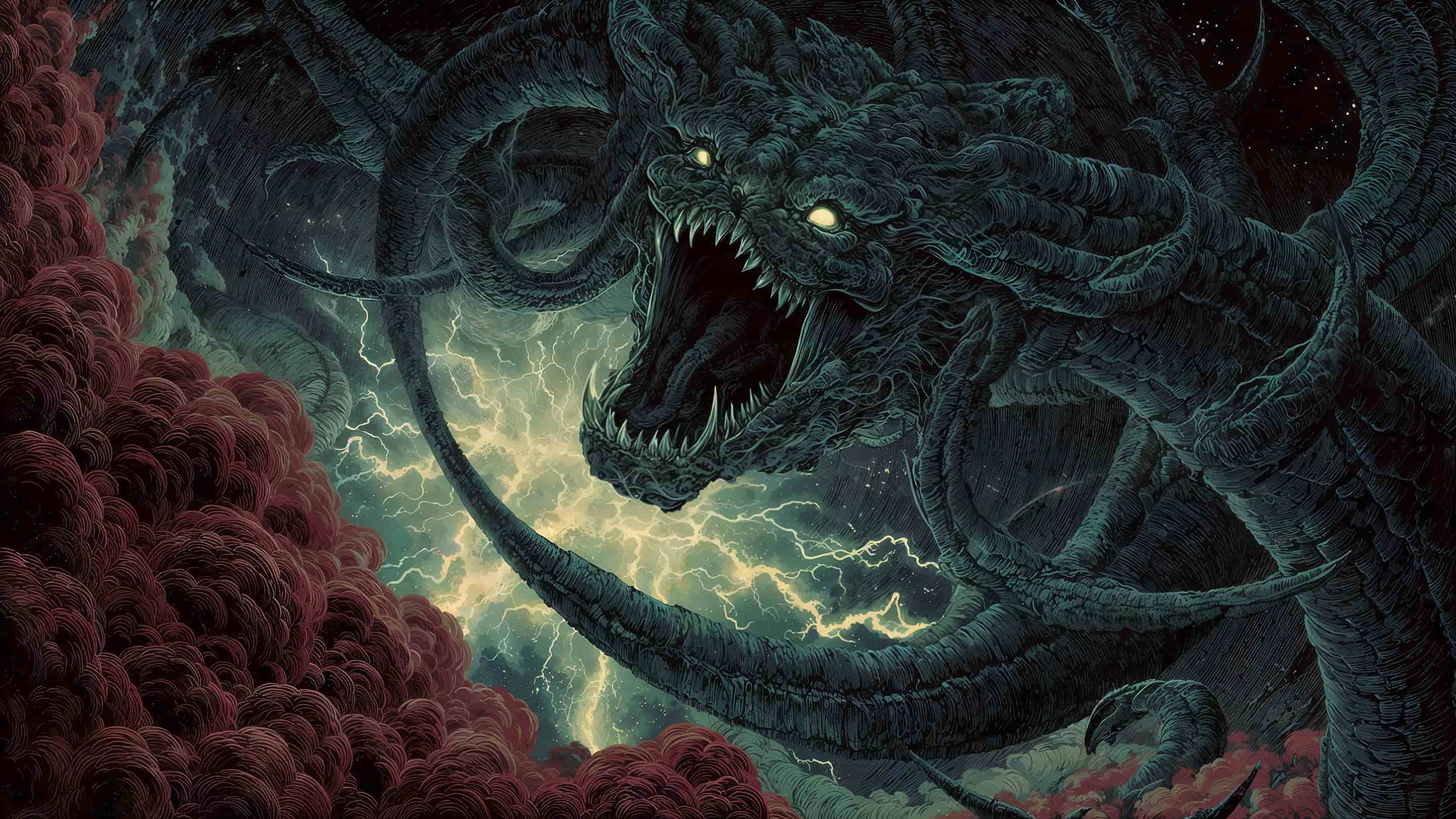
And when she saw (the consequences of) her desire, it changed into a form of a lion-faced serpent. And its eyes were like lightning fires which flash. She cast it away from her, outside that place, that no one of the immortal ones might see it, for she had created it in ignorance. And she surrounded it with a luminous cloud, and she placed a throne in the middle of the cloud that no one might see it except the holy Spirit who is called the mother of the living. And she called his name Yaltabaoth.
This is the first archon who took a great power from his mother. And he removed himself from her and moved away from the places in which he was born. He became strong and created for himself other aeons with a flame of luminous fire which (still) exists now. And he joined with his arrogance which is in him and begot authorities for himself. The name of the first one is Athoth, whom the generations call the reaper. The second one is Harmas, who is the eye of envy. The third one is Kalila-Oumbri. The fourth one is Yabel. The fifth one is Adonaiou, who is called Sabaoth. The sixth one is Cain, whom the generations of men call the sun. The seventh is Abel. The eighth is Abrisene. The ninth is Yobel. The tenth is Armoupieel. The eleventh is Melceir-Adonein. The twelfth is Belias, it is he who is over the depth of Hades. And he placed seven kings - each corresponding to the firmaments of heaven - over the seven heavens, and five over the depth of the abyss, that they may reign. And he shared his fire with them, but he did not send forth from the power of the light which he had taken from his mother, for he is ignorant darkness.
And when the light had mixed with the darkness, it caused the darkness to shine. And when the darkness had mixed with the light, it darkened the light and it became neither light nor dark, but it became dim.
Now the archon who is weak has three names. The first name is Yaltabaoth, the second is Saklas, and the third is Samael. And he is impious in his arrogance which is in him. For he said, 'I am God and there is no other God beside me,' for he is ignorant of his strength, the place from which he had come.
And the archons created seven powers for themselves, and the powers created for themselves six angels for each one until they became 365 angels. And these are the bodies belonging with the names: the first is Athoth, a he has a sheep's face; the second is Eloaiou, he has a donkey's face; the third is Astaphaios, he has a hyena's face; the fourth is Yao, he has a serpent's face with seven heads; the fifth is Sabaoth, he has a dragon's face; the sixth is Adonin, he had a monkey's face; the seventh is Sabbede, he has a shining fire-face. This is the sevenness of the week.
But Yaltabaoth had a multitude of faces, more than all of them, so that he could put a face before all of them, according to his desire, when he is in the midst of seraphs. He shared his fire with them; therefore he became lord over them. Because of the power of the glory he possessed of his mother's light, he called himself God...
Recap: Sabaoth as the Archon
Putting it all together, the picture emerges as follows:
Before the beginning of time, only the Invisible Spirit existed - the True God, the source of infinite Light. From this Light, other divine beings emerged. They're called aeons, and together they presided over the Pleroma - the Fullness of Being, a world of perfection where there is no void, no absence, no death. Each aeon was a part of the Light, but simultaneously had its own distinct identity, its own name and purpose. One of these aeons was Sophia (from the ancient Greek Σοφία - wisdom) - the last, the 12th aeon, completing the Pleroma.
One day, Sophia makes a mistake. Rushing passionately toward the Invisible Spirit, desiring to contemplate Him (a contemplation forbidden to her, for it is accessible only to the Only-Begotten - the Mind), she conceives a thought to create something on her own, without the consent of her heavenly companion-the one who was her partner in eternity (the consort). Her thought, born in solitude, does not remain fruitless. But the result is monstrous: what emerges from it is not a perfect being like the other aeons of the Pleroma, but something distorted. It has the body of a serpent, the muzzle of a lion, and eyes like flashes of lightning-dazzling, but that gives no warmth.
When Sophia sees her creation, she is overcome with horror and disgust. These negative emotions finally solidify the nature of the being she will name Yaldabaoth. Sophia decides to conceal him: she places him outside the higher spiritual worlds, surrounds him in a cloud of light, and seats him on a throne.
Yaldabaoth received a portion of his mother's power, but he didn't understand its origin. He was blind. He didn't know where he came from. He didn't know that somewhere there existed the Pleroma, the aeons, the Invisible Spirit. Nothing but himself.
The Gnostics gave him three names that describe his essence:
- Yaldabaoth - "child of chaos," a reminder of his birth in ignorance.
- Saklas - "fool", for he acted without knowing what he was doing.
- Samael - "blind god", for he was blind to the ultimate reality.
Separated from Sophia, Yaldabaoth began to create his own world, copying the images of the higher world he couldn't see. Endowed with power, he uses it to create other beings similar to himself. This is how the Archons were born:
In Gnostic beliefs, archons are overseers of the material cosmos, making man a slave to matter.
Each of them received its own name and sphere of influence: Afon, Harmas, Kaila-Umbri, Iabel, Adonaiou, Cain, Abel, and others. There were 12 of them in total: 7 ruling the heavens, 5 ruling over the abyss. Later, the archons created another 365 angels, tied to each day of the year, each movement of the stars, and each law of the material world.
Among them, the 5-th archon Sabaoth (Adonaiou) stands out, whom the Old Testament calls its God. He has the zoomorphic appearance of a dragon and belongs to the world of the "seven powers", ruling the material cosmos through fear, law, and sacrifice.
In other Gnostic texts (for example, in the treatise "On the Origin of the World"), Sabaoth appears as the son of Samael, who later rebels against his father and receives a separate kingdom from Pistis Sophia (Faith-Wisdom) - another aspect of Sophia that performs a saving function.
The relationship between Yaldabaoth and Sabaoth varies across Gnostic traditions. In the Apocryphon of John, Sabaoth is one of seven archons created by Yaldabaoth. In other texts, like "On the Origin of the World", he is Yaldabaoth's son who rebels against him. And in several Gnostic sources, Yaldabaoth himself is identified with the Old Testament Yahweh (Jehovah) - also known as Sabaoth, "Lord of Hosts". What remains consistent across all versions is this: both belong to the world of archons, the cosmic rulers who demand worship and sacrifice.
The Connection to Loosh: Archons as Energy Harvesters
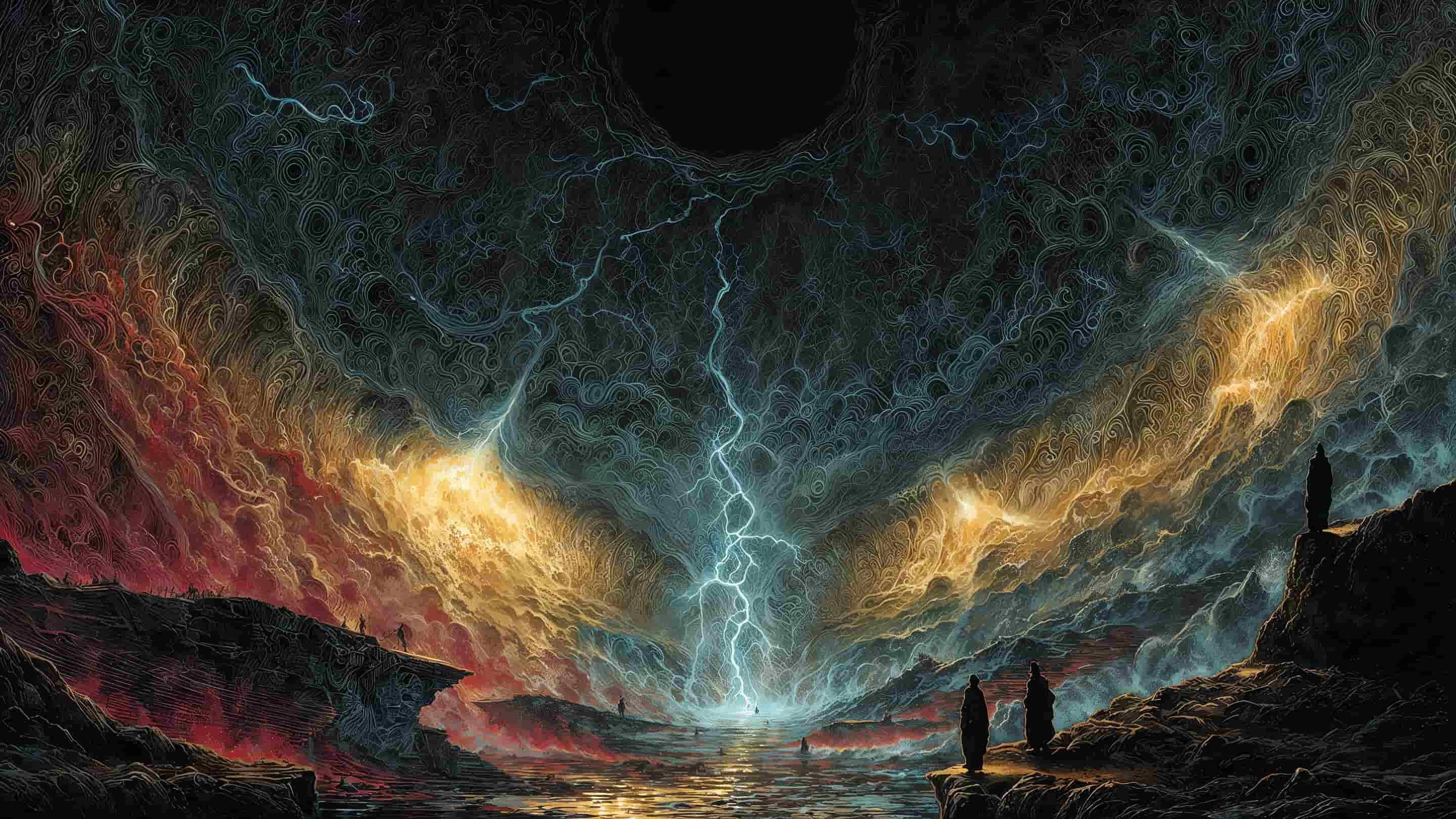
And here we come to the main point - why we need this conversation in the context of the Loosh hypothesis. If our emotions (especially fear, pain, and suffering) are a resource, food for non-physical entities, then who are these "non-physical entities"? The Gnostics would have called them archons. Look at the portrait of Samael/Sabaoth:
- Blind - unaware of the true source of light
- Stupid - acts out of ignorance, but with colossal power
- Jealous - declares himself the only god, but is jealous of one he does not know
- Demands worship and sacrifices - the entire Old Testament is full of descriptions of sacrifices, the smell of which is "pleasing to the Lord"
- Rules through law and prohibitions - the very system that "makes man a slave to matter"
What is sacrifice if not the technology of producing Gavvah? An animal in agony, blood, fear, death throes - all these are the very emotions Monroe called Loosh. And to whom are they offered? There's a moment in the Apocryphon of John when Yaldabaoth speaks through his angels:
I am a jealous God, and there is no other God beside me
But the irony is that by declaring this, he revealed to the angels that there was another god. After all, if there was no other, of whom could he be jealous? Jealousy is only possible where there is an awareness - even if suppressed, even if bordering on ignorance - that Someone higher exists. But instead of repentance, the Archon chooses another: he demands sacrifices to prove to himself and his subordinates that he is the only one. Every drop of spilled blood, every cry of agony fuels his illusion, his egregor, his power.
Interestingly, when Sophia gave birth to Yaldabaoth, part of her own light remained within him. And this light - a spark of the divine - passed on to all the archons and their creations. Therefore, the world created by the blind god was not absolute darkness. It became a mixture: light mingled with darkness, the darkness partially illuminated, the light partially dimmed.
Conclusion: The Blind God and the Harvest
From all of the above, it follows that the material world was created not by the All-Good Father, but by a lower demiurge - an archon - who doesn't know the true God and considers himself the only one. The archons rule the world through a system of prohibitions and commandments, through fear and law. Robert Monroe, in his out-of-body experiences (OBE), described a world where higher beings feed on human emotions-especially pain and fear. It turns out that the archons are the very same Loosh collectors.
Sabaoth, whom the Old Testament calls God, is one such archon. His form is that of a dragon. His nature is blind ignorance. His method is the demand for sacrifice and jealousy of those he does not know. His goal is to subjugate man to law, matter, and fear, so that he spends his entire life producing the very energy that feeds the world of the archons.
And then the question - will humans become conscious beings capable of breaking free from the food chain, or will they remain Loosh energy generators for the "blind god" and his minions? - is, as always, open to each of us. But understanding how this world works can be the first step toward liberation from their power.