Food for the Moon: Gurdjieff and the Theory That Something in the Sky Is Eating Us
Look at the moon in the sky tonight. Really look. It's hanging there, lifeless and quiet, as if waiting for something. Most would consider that to be poetry. A mood. An illusion created by the mind. But I'm starting to think it's not.
Before we get deeper, if you haven't read the piece about loosh yet, then read it first. The short: researcher Robert Monroe has found that human emotional energy (which rises most during times of fear, pain, grief and death) is being harvested by beings higher up on a cosmic food chain. It's the fuel that keeps something living. The full breakdown is available here.
Now. So, what has all of that to do with the moon? Everything, as they say!
A Man Who Said the Quiet Part Out Loud
George Gurdjieff (1871-1949), was a mystic and teacher of Greek-Armenian origin. He founded one of the strangest spiritual philosophies of the 20th century, the Fourth Way, and attracted the serious and intelligent followers from Europe and America. He was by no means a fringe crackpot. He was a sort of man who would enter a room and make all the other people feel like they'd been sleepwalking until that moment.
One of the lessons he taught, and imparted in a steady, no-nonsense, nonapologetic way, was this:
All life on Earth is food to the Moon.
Not a metaphor. Not a symbol. Food.
The Moon Is Hungry
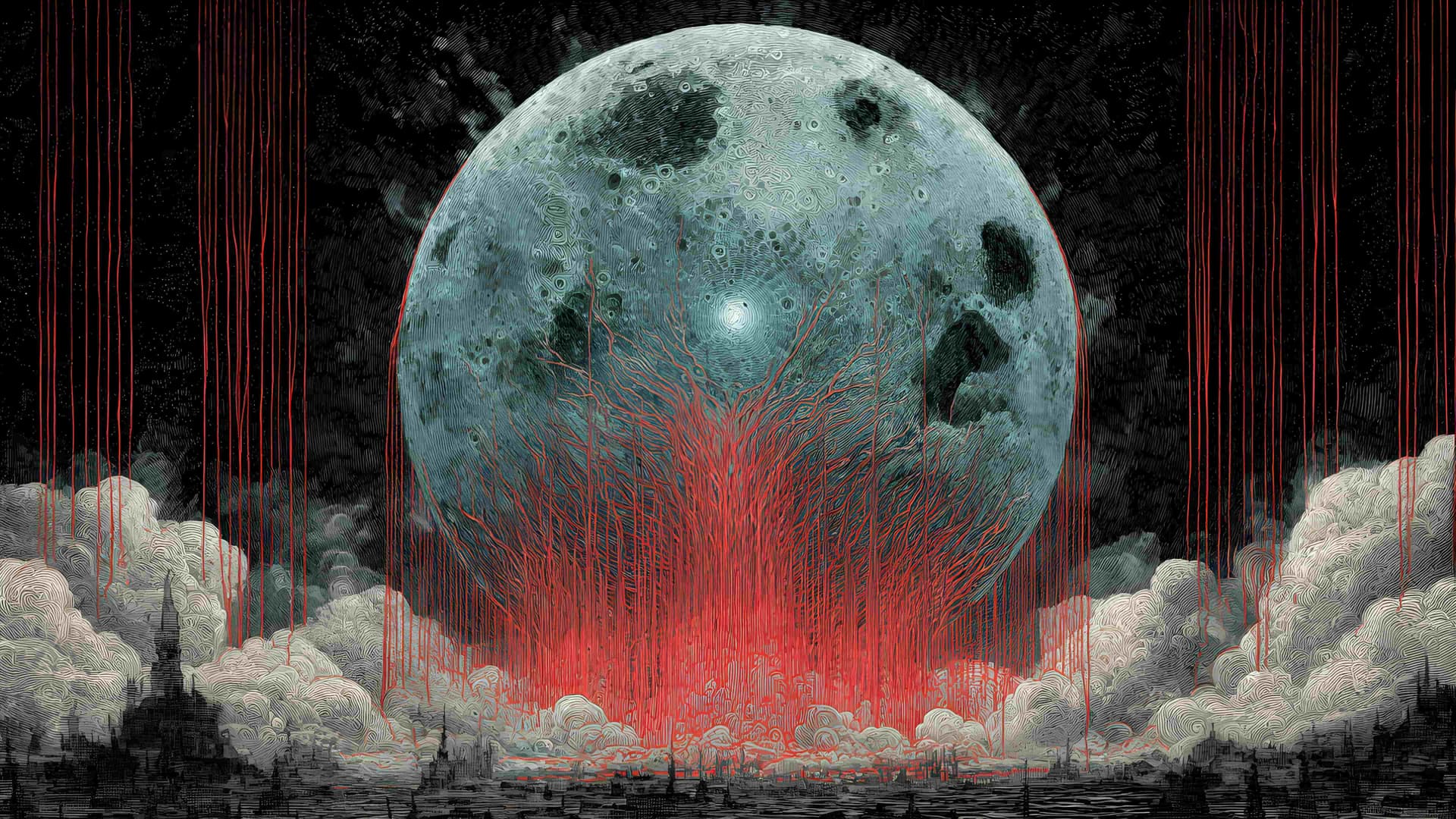
Here's the cosmic picture Gurdjieff painted. In his opinion, the moon isn't a solid stone. It's a planet that's still in the process of being born. It's still a "cosmically speaking" fetus, without an atmosphere, without water, without life itself. Like all fetuses, it has to nourish itself some other way to grow. And this is you and me.
We humans, animals and plants are all a feeding tube. We get energy from the sun, and from the processes of living. We lose part of our energy when we die, and it gets pulled up. Toward the Moon. Like smoke rising from a fire it didn't ask to be part of. It was written down by Gurdjieff's student Ouspensky:
When something dies one part remains in the earth, and the other goes to nourish the moon.
If you multiply that by all the creatures that have lived and died on this planet over thousands of years, you'll get a pretty large number. A lot of smoke there is!
The Sheep Don't Know They're on a Farm
What I find hardest to get out of my mind about Gurdjieff's conception isn't the death part. It's the living part.
He didn't say the Moon only collects when we die. He said it has a grip on us while we're alive too — pulling at the mechanical, automatic parts of our behavior. The flare of anger that comes from nowhere. The anxiety that sits in your chest for no reason at all. The low-grade dread that shows up on a perfectly ordinary Tuesday. Gurdjieff's view was that these reactions aren't really yours. They're the Moon's hands inside a puppet.
There is the mechanism that keeps us blind to all this named kundabuffer. This is a specific detail from Gurdjieff's Beelzebub's Tales:
An organ that was supposedly intentionally implanted at the base of the human spine so that people would perceive reality backwards—that is, find pleasure in what destroys them, and not notice that they are being milked.
And he also had a name for what we're in this agreement. Sheep.
We're like the Moon's sheep which it cleans, feeds and shears, and keeps for its own purposes.
Please note. Shearing is a process that's repeated, applied to a living animal and then the animal is released and wool grows back. It doesn't have to die. It only needs to continue to give birth.
Sound familiar? If you've read the loosh piece, it should. The two mechanisms described by Monroe and Gurdjieff are almost the same under the guise of different words. The most energy is created from suffering and fear. Both are produced by the system. And the end of the chain doesn't have to kill us, it has to make us run.
Two Men, One Elephant
In the latter part of the 20th century Monroe was an American businessman who became a consciousness researcher. Gurdjieff was a Caucasian mystic from the early 1900s, who was influenced by traditions that extend back centuries. No evidence that they ever met or read each other. And yet.
Emotional energy, particularly from pain and death, is harvested by trans-dimensional beings and used to prolong their lives, Monroe said. According to Gurdjieff, the psychic energy of the dying organic body nourishes a developing cosmic body which dictates our action while living.
Different words. Same shape.
That's the one thing I can't get rid of. If two totally independent systems, constructed by two different groups of people with no apparent relationship to one another, both wind up at the same basic structure, that's, something is eating us, has to eat our pain rather than our happiness, and has an interest in keeping us asleep, I don't call it coincidence, I call it a sign. If you want to go further down this road.
The One Way Out
Gurdjieff wasn't totally disheartened about it, and you shouldn't be. He said:
Truly waking up, not just reading about enlightenment, means liberating yourself from the Moon. Not after death, not through some magical escape, but through awareness. If you actually see your fear instead of being run by it, if you catch your anger before it automatically explodes, if you stop being a mechanical animal - then you become harder to shear. You're simply less useful to this farm.
If Monroe's right that suffering and unconscious emotional reaction are what produce the most loosh - then the most radical thing a person can do isn't protest, or prayer, or even enlightenment in the traditional sense. Just: observe what is going on in you, rather than identifying with it.
Perhaps this is an answer that's too small for this problem. I thought so initially. But then I wondered what the other way is like: to live without purpose, to bleed energy at every emotional peak, never inquiring of what it is or where it trully goes.
And I decided I'd rather to try.