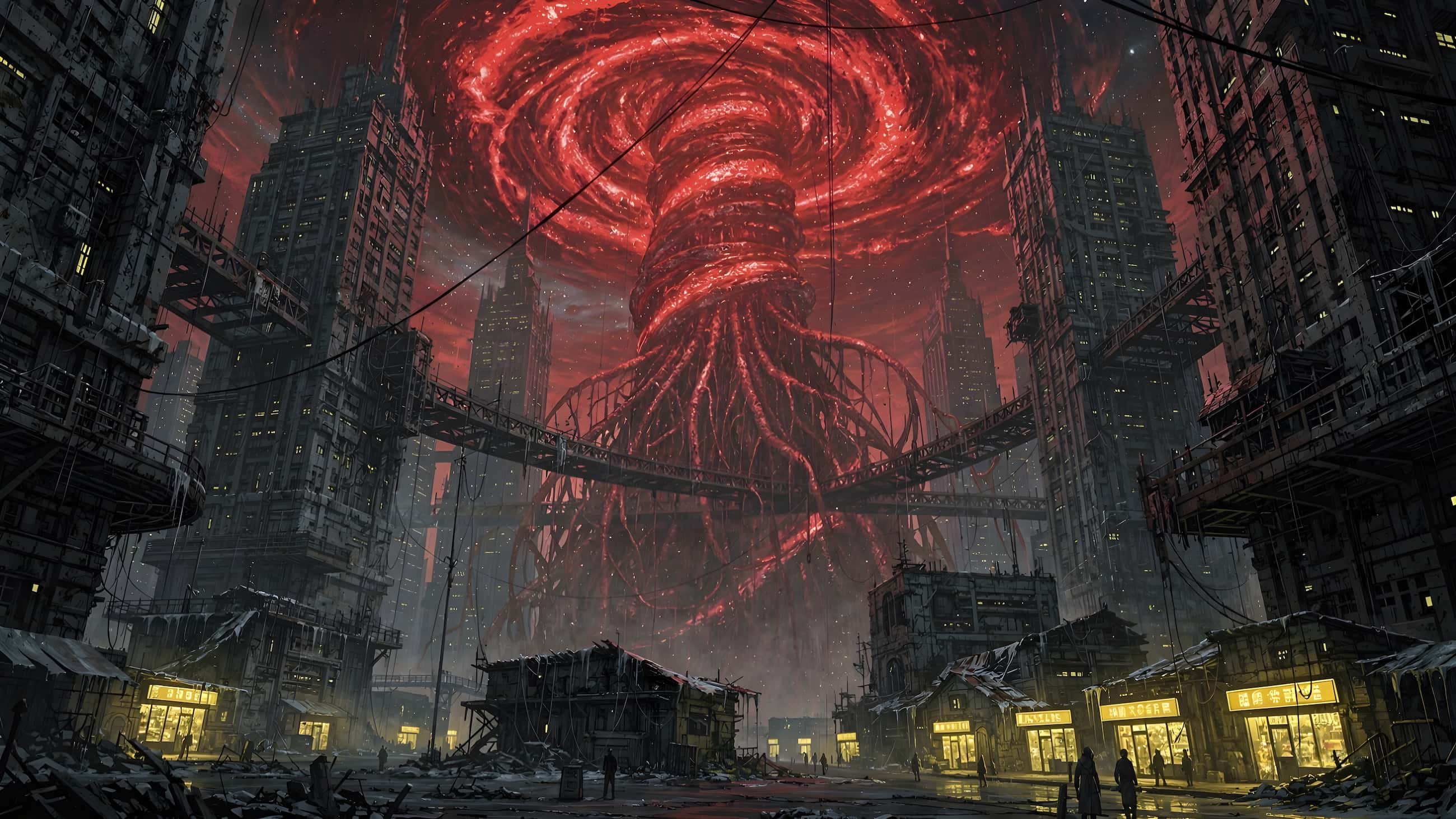
Wetiko: The Mind Virus That Has Been Feeding on Humanity for Centuries
There's something eating human beings. Not the body. The mind. The ability to see the other life as real and feel the burden of another person's life as real as your own - that is what gets consumed. What's left is a functioning human being who can speak, plan, build empires, write laws and inflict so much suffering on others that they never experience themselves.
The Cree, Ojibwe, Algonquin peoples of North America had a term for this condition. They called it wetiko.
What Wetiko Actually Means
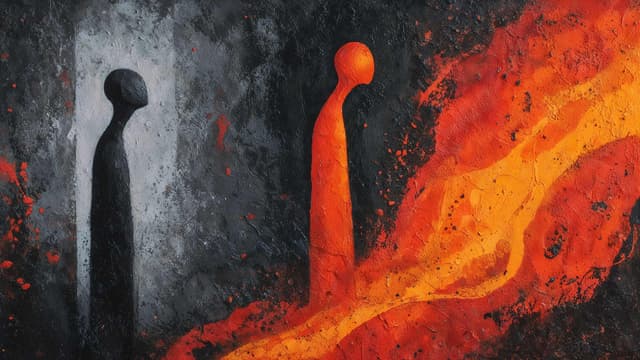
The term is derived from the Cree word wîhtikow, which refers to a cannibal spirit. It's a creature that lives by consuming others. That spreads through consumption the way a disease spreads through contact. Originally a mythological giant ice monster, wetiko was described as the one whose heart was literally frozen. It devoured human flesh and expanded in size with each bite. The more it ate, the more it wanted. No satiation point was found. The hunger was the condition.
Algonquin-speaking cultures did take it seriously to classify it clinically. The Cree had already diagnosed centuries ago what Western psychiatry would later come to call psychopathy, narcissistic personality disorder, or sociopathy: a person whose ability to feel was replaced by pure appetite. The infection was thought to be contagious.
In 1979, a historian named Jack Forbes published a book called Columbus and Other Cannibals. Forbes was Powhatan-Lenape and he was trying to convey something that was confusing to him. Not only the violence of European colonialism - the magnitude of it could be accounted for in terms of greed and power. What he didn't understand was the excitement. The eagerness to take and to kill. The joy that can be seen in the documents and testimonies from the time. Lack of any sign of moral conflict in the perpetrators.
Forbes contended that Columbus and subsequent explorers were not just violent men in a violent system. They were wetiko; they were carriers of a psychic disease that had already ravaged much of Europe before it came to the Americas and that the Americas became infected with as a second infection.
Forbes' analysis of the disease was not metaphorical. He meant it as a precise description of a contagious illness that gradually erodes the host's ability to see the humanity. And his appetite was increasing.
What This Has to Do with Loosh
Robert Monroe explained the mechanics of an energy system. Loosh is produced by living beings under conditions of emotional intensity - fear, grief, longing, the extreme of any experience. It is harvested by non-physical intelligences. The system is maintained by creating life in a way that maximises the harvest.
The loosh hypothesis relates to the structure of the extraction. Wetiko is about the mechanism of its perpetuation within human society.
When a being is colonized by wetiko, it's at the same time a loosh generator and a loosh distributor. It creates its own suffering - hunger that can never be satisfied, the emptiness at the core of a life geared around consumption. It causes the pain in all those with whom it comes in contact: the pain of the dispossessed, the terror of the colonized, the slow corrosion of anyone who has been sustained in an extractive relationship.
The wetiko-infected individual does not experience this as cruelty. They feel it as a need. Hunger is real. Eating is a way of survival.
This is one mechanism that the loosh hypothesis requires but does not explain on its own. Monroe was able to determine what and who is being harvested. Forbes found out how the harvest is maintained within human civilization - it's done by the propagation of a psychological state in which human beings are turned into means of extraction.
The Modern Psychiatrist Who Took It Seriously
Paul Levy is a western-trained psychiatrist with years of experience treating patients with severe trauma before meeting Forbes' work. Levy's book Dispelling Wetiko of 2013 stated that wetiko is not a metaphor or an ancient cultural idea. It is a detailed description of a phenomenon that can be seen in human psychology in fragments, as in conventional psychiatry: dissociation, narcissism, the ability to kill without remorse, but never as an integrated whole, a single phenomenon that can be transmitted.
Levy's role was to trace wetiko through the systems of collective human behavior: financial systems built around extraction, political systems that are maintained by manufactured fear, media environments that are tuned to outrage. He was not arguing that there were bad actors who were infected with wetiko. He was saying that the institutions had become the structure of the disease, wetiko had infiltrated from individual hosts into the structure of civilization.
This is where the concept gets really challenging.
If wetiko is an infection that spreads through contact, then the ability to empathise is slowly being lost and the appetite for consumption is growing. And if it has been around for centuries in the institutions that humans inherit at birth, then the question isn't whether or not wetiko exists in human civilization. The question is, is there anything else?
The Frozen Heart
In the original mythology, the frozen heart was the wetiko's defining feature. There's no lack of emotion - the create experienced hunger, urgency, and intensity. What was absent was the capacity to feel the reality of what's was consuming. Other lives were not counted as lives. They were registered as food.
It's that specific quality that Forbes discovered in the colonial documents. Not a lack of passion - the settlers were often passionate, devoted to their God, their king, their mission. When they destroyed others, there was no evidence of internal experience. They were not affected by the destruction. They moved on.
The frozen heart is the signature. Once you know where to find it, it's there in some places you don't want to see it.
The loosh hypothesis is a structural question: "Who designed this and why?". Wetiko poses a nearby question that might be more difficult to sit with.
What if the design doesn't require an external architect? What if a sufficiently effective psychic parasite could, over sufficient time, produce a civilization that maintains the harvest conditions entirely by itself?
The fields don't need to be managed if the crops have been taught to manage each other.
There is a fish parasite called Cymothoa exigua. It penetrates through the gills and then attaches to the tongue. When the parasite starts eating it, it's not killing the host. As the tongue atrophies, the parasite replaces it. It attaches itself to the muscle stub, thereby using it as a replacement organ. The fish continues to eat. The parasite takes a bite out of each meal. The host is alive because a dead host means no production. What makes this particular creature so difficult to look at directly is not its violence. It is its patience. It does not destroy. It substitutes. It becomes structural. Wetiko works by the same principle. It does not hollow the host out completely - a dead human produces no useful product. It's a substitute for something particular: the ability to register other lives as real. The host is still operating. It goes on talking, planning, building, eating. The parasite intercepts the part that would otherwise generate resistance.
The concept of wetiko connects directly to what Castaneda's don Juan described as the foreign installation - a mind implanted in human beings that serves not the host but the harvester. The Gnostics mapped the same territory through the archons. Monroe named what they all circled: loosh.