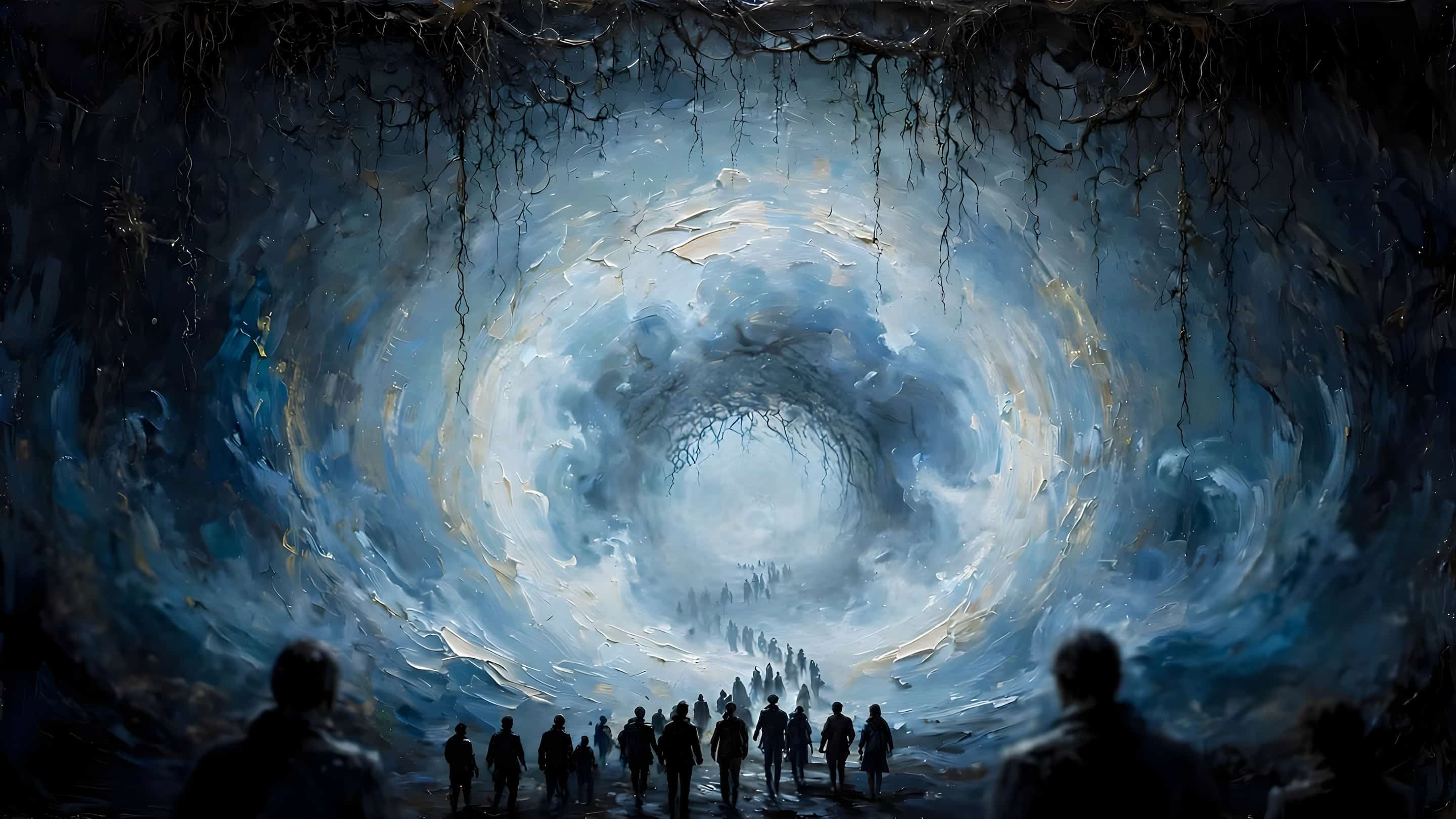
The Cover Knows Too Much
A Cover That Keeps Guessing Right
The Economist magazine is released every year with a cover that contains dozens of small images, all of which are supposed to add up to "the year ahead. And every year, within the months, folks being screenshotting it along side actual headlines that appear to be a bit too close to the mark.
There's a mundane answer to this and it has nothing to do with paranormal. With a hundred little things in a hundred little places in this little drawing, there is always a certain number of things that are uncanny. It's not a conspiracy - it's the nature of math. Leave an image of any busyness enough a year to be torn apart against reality and something will align.
Genuinely good, but it's just not enough.
The Boring Explanation and the Other One
There are two ways an institution could keep guessing right, year after year. The boring one: skilled analysts, briefed by people who actually shape policy, turning informed guesswork into imagery - because that's simply the job. Smart forecasting dressed up as art. That's most of it, probably.
An institution has two options for it to continue to guess correctly, year after year. The boring one: the informed guesswork becomes imagery, as it's just the job done by the skillful analysts briefed by those who actually make policy. Art that is really smart forecasting. Well, that's about it, I suppose.
The other explanation only gets interesting once you ask a sharper question: forecasting can predict trends. It can't predict specifics. Trend-watching gets you "unrest," "a rough year for markets," "instability somewhere." It doesn't get you one small, oddly exact detail, buried in a crowded image, years before the specific thing it points to even exists.
So if a handful of details are too exact to be explained by trend-watching, only two options are left: either someone is secretly engineering real-world events to match the picture, or someone already knows the outcome and is quietly encoding it after the fact. The first would require an almost impossible level of coordination across systems that don't even cooperate with each other. The second requires only one thing to be true: that information can travel backward in time.
What Physicists Actually Think About That
This is the part people usually rush past - either laughing it off as science fiction, or treating it as already proven. Neither reaction is accurate.
Here's the part that surprises people: Einstein's own equations don't say no. General relativity - the theory that describes gravity by bending space and time itself - has known solutions where time doesn't just move forward in a straight line. It loops. Physicists call these "closed timelike curves," which is a dry name for a wild idea: a path through spacetime that eventually leads back to where - and when - it started.
The math doesn't work for just any old corner of the universe. You'd need something extreme: a black hole spinning fast enough, or a wormhole - a kind of shortcut tunnel stitching two distant points in space together. Nobody has ever found one, let alone built one. Most physicists suspect nature has a built-in safeguard against this - some deeper rule we haven't discovered yet that quietly slams the door shut before a loop like this could ever actually form. But here's the uncomfortable detail: that safeguard is a suspicion, not a proof. On paper, right now, the door is still technically unlocked.
Meanwhile, the culture around CERN's Large Hadron Collider - the massive particle accelerator built to smash atoms together and study the results - has flirted with this exact idea more than once. In 2016, a story spread fast online claiming a CERN scientist had traveled to the future and come back with a warning. It was completely made up, and debunked within days - but it spread just as fast as anything true that year, because people wanted a machine capable of that to already exist.
Years earlier, physicist Stephen Hawking actually ran a real experiment on this exact question. He threw a party for time travelers - but sent out the invitations only after the party had already happened. His reasoning: only a real time traveler, reading about the party in the future, could ever know to show up. Nobody came. Hawking called this a serious result dressed up as a joke: if backward time travel is possible, we should expect to see almost no evidence of it, because anything stable enough to allow it would also be stable enough to hide almost all trace of its own use.
That's the part worth sitting with. "We can't detect it" is not the same thing as "it isn't happening." In fact, undetectable is exactly what you'd expect to see if something like this were being used carefully.
What the Registry Already Assumes
The Kenoma-1 registry lists, among its stated environmental facts, that time inside this system runs strictly LINEAR - one direction, no exceptions. Stated as fact, not measured as fact. The same registry also declares that exit is NOT POSSIBLE, and that the outer boundary of the system is UNDEFINED. A closed system doesn't actually need real time travel to exist for the claim of one-directional time to be doing serious work on its behalf. It only needs residents who never think to question it.
If something is administering the quotas on a system this large, knowing the future in advance would be its single most valuable resource - worth more than any physical asset, because it lets everything be positioned ahead of time without ever looking like anyone is in control. A magazine cover that keeps guessing right isn't proof of a leak. But it's exactly what a leak would look like from the outside - filtered through people doing honest, competent work, encoding a feeling they can't quite explain but trust anyway.
Maybe that feeling has a name. Maybe it's just good analysis, every single time, forever. Either way, you're being asked to believe in something you can't verify. Only one version of that is comfortable.