Architecture of Scarcity
The Question Nobody Answers Honestly
There're billionaires whose wealth would last a thousand lifetimes. But if you ask one of them why they continue to pile up more and more, they'll either dodge the question, or resort to platitudes such as "growth" and "opportunity" - which mean nothing at all.
I suppose it's worth considering: When you have more wealth than you can possibly imagine, why isn't that enough?
The word that springs to mind is greed. But I don't believe that word explains anything. it's only a term for a pattern of behaviour, nothing more. Greed is a description and not a mechanism.
Scarcity Doesn't Require Actual Scarcity
Behavioral economics has documented an interesting phenomenon, called "loss aversion". Losing something is about twice as bad as gaining the same thing. This simple observation was the very foundation of Daniel Kahneman's career, and ultimately, his Nobel Prize.
Now extrapolate this to someone who has already been successful by all conceivable measures. They don't fear scarcity, they fear the loss of their relative position to others. It doesn't matter if they have the resources to support an entire little nation. At the level at which our nervous system operates there's only one thing that matters: if he's not reached by someone behind him.
This isn't a flaw in a few individuals. Robert Hare's research on psychopathy - the actual clinical kind, not the pop-culture version - found something uncomfortable: measurable psychopathic traits show up in corporate leadership at several times the rate found in the general population. Charm, ruthlessness, absence of guilt, comfort with instrumentalizing other people. These aren't obstacles to reaching the top of steep hierarchies. They're advantages.
Put those two facts together and you get a structural, not moral, explanation: the archetype at the top of any sufficiently steep hierarchy isn't selected for wisdom or restraint. It's selected for the specific psychology that treats enough as a concept that doesn't apply to them.
Conflict Is Always a Product
War is expensive to fight and profitable to finance. This isn't shocking - economic historians have documented war profiteering for as long as there have been records to study, from grain merchants in besieged medieval cities to defense contractors whose shares move on news of new conflict. Scarcity, conflict, and crisis generate concentrated financial gain for the narrow set of actors positioned correctly around them.
What's rarely asked is the metaphysical version of the same question. If the energy of suffering is a real resource - if fear, loss, and desperate competition produce something that can be extracted, the way Robert Monroe's loosh hypothesis proposes - then engineered conflict isn't just profitable in dollars. It's profitable in the currency this entire blog is built around.
Two economies running on the same fuel (one visible and one not) would look, from the outside, exactly like what we already have.
The Ones Who Never Have to Compete
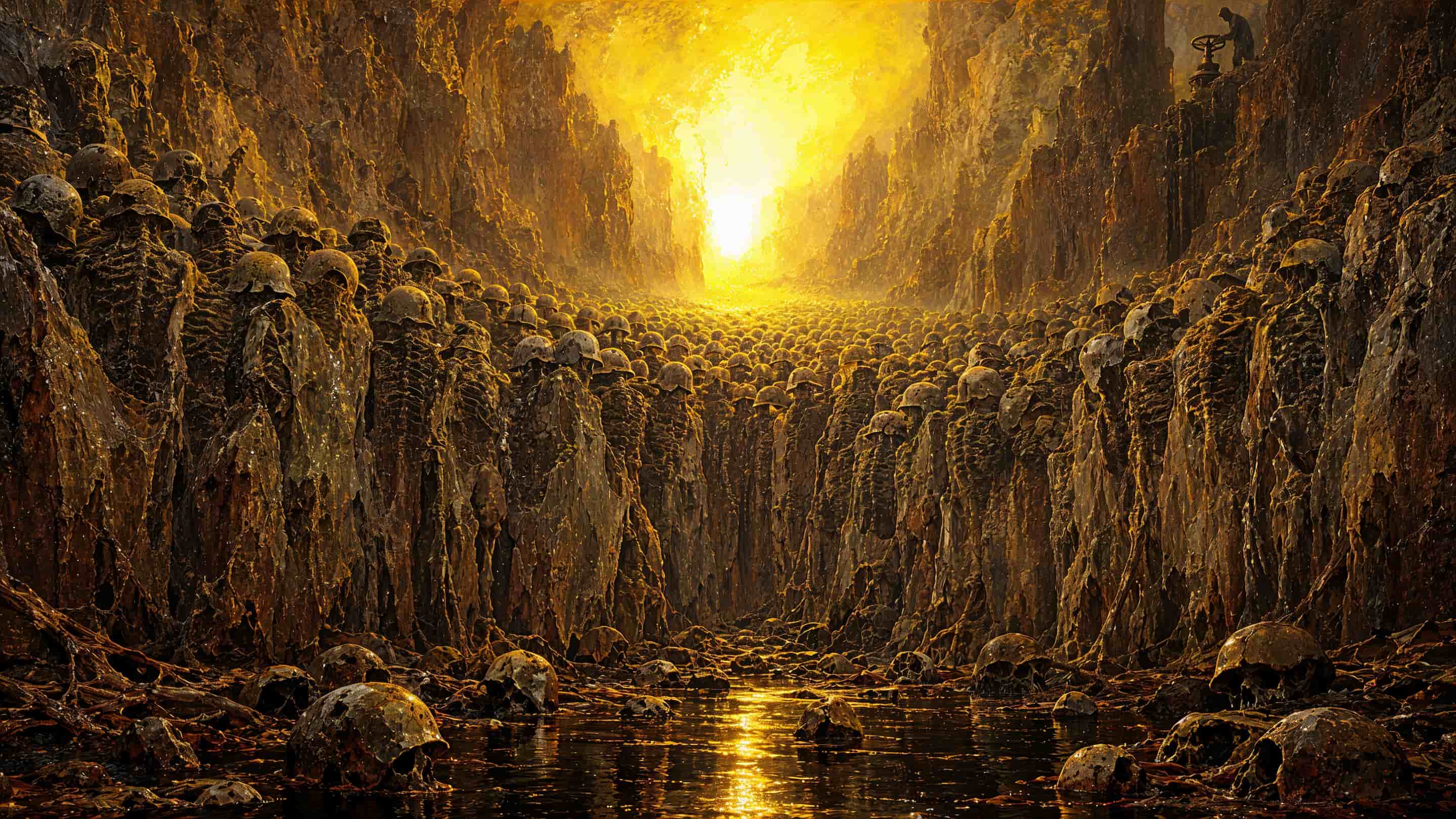
Every hierarchy needs administrators - the layer that doesn't originate the extraction but manages its throughput, sets the quotas, keeps the machine running without needing to understand why it runs. In the Kenoma-1 registry, that role belongs to a specific class of entity: not the architects of the system, not its source, just the ones who make sure the harvest stays within acceptable range.
Human hierarchies mirror this with uncomfortable precision. The people who benefit most from manufactured scarcity are rarely the ones designing the wars, the shortages, the manufactured crises. They're the layer that administers the resulting conditions - who gets the loan, who gets the contract, who gets to keep climbing and who gets quietly filtered out at each stage. Nobody at that layer needs to understand the full system. They only need to enforce the quota.
That's what makes the structure durable. You don't need a single mastermind. You need a self-sustaining hierarchy of psychopathic selection where each layer polices the one below it, convinced they're just doing their job.
Was This Ever the Plan?
The flaw in creation is that suffering was implemented deep enough to be mistaken for nature. That raises the uncomfortable question every gnostic cosmology eventually faces: was the world designed to run this way from the start, or was it taken over after the fact?
The gnostics had an answer for this that most people never encounter outside a seminary. The god who made the material world - the demiurge, blind and lesser, mistaking himself for the only god - is not the true source. He's a flawed subordinate who built a flawed system and doesn't know it's flawed. Whether that's literally true or the most useful metaphor humans ever produced for the same observation, the shape of the idea holds up: something is running this place, and it isn't obviously benevolent, and it isn't obviously the original architect either.
If the extraction economy is real, it doesn't need a single evil genius pulling every string. It needs exactly what any farm needs: a self-perpetuating structure where cruelty is rewarded up the chain, competition is kept artificially scarce, and everyone below the top few layers is taught that this is simply how the world works. Not a conspiracy. An ecosystem.
Which might be the more disturbing possibility. A conspiracy can be exposed and ended. An ecosystem just keeps regenerating the conditions for its own harvest, indefinitely, with no one left to blame and no one left in charge.