Something is Watching You Sleep
The Night You Couldn't Move
You wake up but can't move. You are paralysed and flat. You can see through the ceiling. You're awake and alert, but someone is holding you down. And then you feel it. A presence. Occasionally standing in the corner. Occasionally resting on your chest. Sometimes just behind you. In the portion of the room that you can't turn around to see.
If this has occurred to you, you know what I'm talking about. If not, you're in luck or uninitiated.
The prevalence of sleep paralysis ranges from eight to fifty percent of people at least once in their lifetime. The official answer is simple and straightforward: the brain awakens from REM sleep while the body is chemically paralyzed, to prevent you from enacting your dreams. Hallucinations occur. Pressure on the chest is hyper-awareness of breathing. Your brain is going haywire.
The Entity Problem
The neurological explanation doesn't answer this question: why do everyone see the same thing?
In 14th century Germany, it's called the Old Hag. One Newfoundland fisherman refers to it as the Night Hag, saying that it sits on his chest until he can't breathe. It is found throughout West Africa under the name Ogun Oru. In Japan, it's Kanashibari, a pressure that pushes you down into the bed without you being able to feel it. The Karabasan, a dark figure in the corner, is a popular motif in Turkish art. In the Hmong community of Southeast Asia, it was so feared that men would die in their sleep while experiencing this and doctors would record them as having an unexplained cardiac arrest.
Same experience. Same entity. There was no common mythology, no cultural or historical links, and no shared cultural context. It was the same scenario each time, downwards pressure, presence, terror.
The common explanation would be that humans under stress would create similar patterns in their brains and hence similar hallucinations. Possible. However, this doesn't account for the specificity of content. Not everyone experiences hallucinations of light, geometry, noise. Everyone's got a ghost in their head. A person or thing that is dedicated to us. A person or a thing that observes.
This is no accident. That's a pattern. And patterns mean something.
My Personal Story
That night I was home alone. I woke up after another sleep cycle, as usually happens to everyone. It was 3:39am. After thinking about the dream for a bit, I turned on the left side to fall asleep again. As soon as I turned over, my body seemed to freeze.
I felt that something jumped on my bed. It passed behind my back barely touching my shoulder. It was long-haired and slow. Its fur was tickling my cheek like a cat. I could feel each strand of it.
I couldn't move. I was trying to force my body to wake up. But I was fully conscious, trying to get the words "Shoo, shoo! Get off, get off me!" out of my mouth. Those 30 seconds felt like neverending, because time flew differently in that state. Finally I managed to get a grip, because of a strong desire to get out of that mire. I got out of bed. Turned on the light and tried to figure out what it was.
Remarkably, I had just turned onto my other side when this happened. It was too little time to fall into deep sleep and cause such a hallucination. So tactile, so coherent and specific. Why has this never happened when my wife is nearby? Only when I'm alone. Why is this not happening at 1:12am or 6:43am? Why does it have to be between 3:00 and 4:00am? What's special about these numbers?
Whatever this was, it didn't wait for me to be deeply asleep. It came when it wanted.
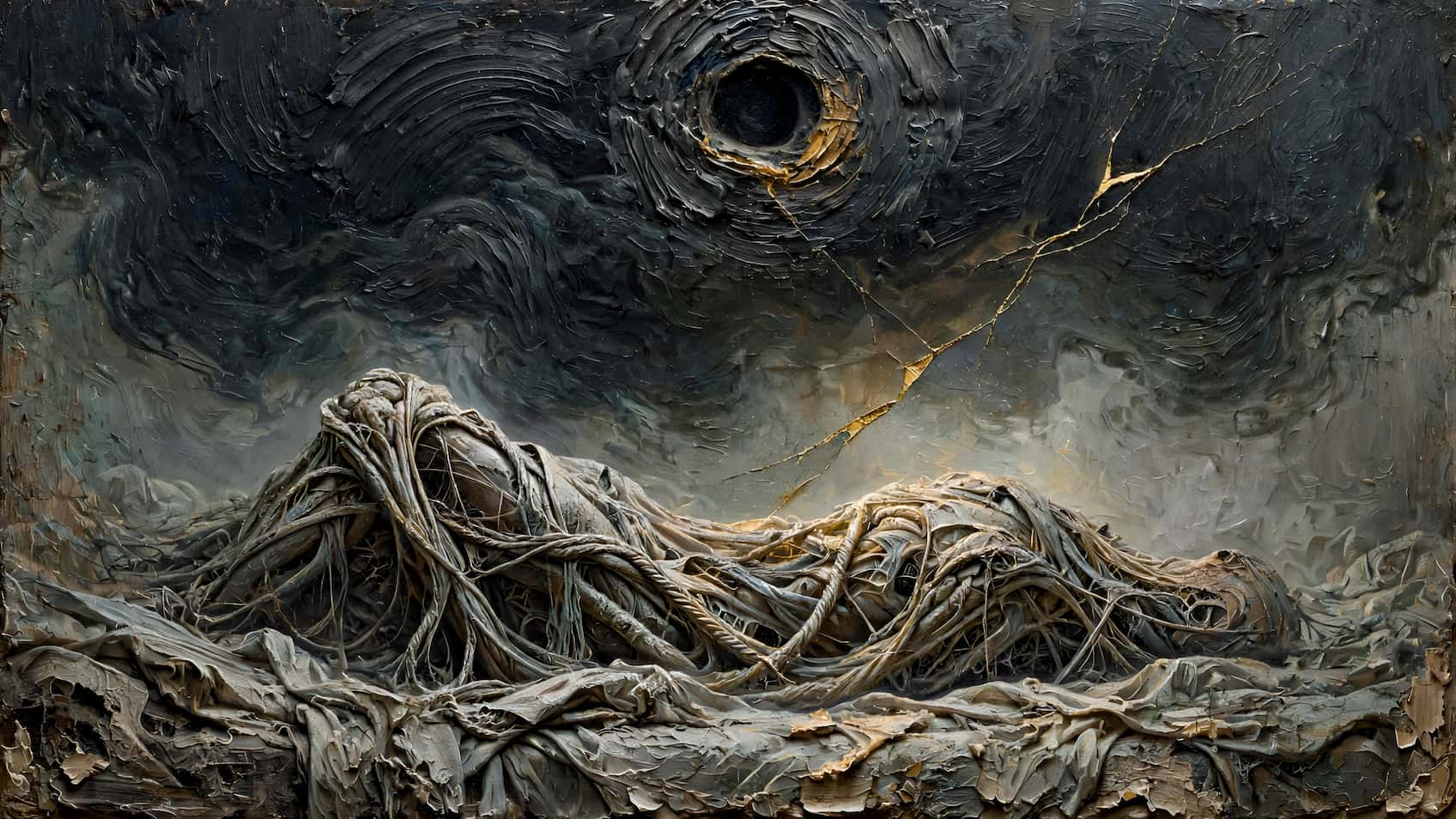
Monroe Started Here
Robert Monroe was not the one who intended to record entities. He was a radio executive doing research on the effects of audio frequencies on learning. Soon the paralysis began.
His first out-of-body experiences were nearly identical to those people report during sleep paralysis. Vibrations in the body. Complete physical immobility. And then presences - some neutral, some that he described, in his clinical field-report voice, as observing without interest. The manner in which you might observe livestock.
Monroe's word, not mine.
He believed that these were his hallucinations. It wasn't until years later, after years of involuntary OBEs and the slow development of the loosh hypothesis, that he came back to those early paralysis states with new eyes. The creatures he encountered were not merely the fruit of his misfiring brain. According to his report, they were gathering something. In those moments he felt evaluated.
The Optimal Harvest Window
Think about what happens physiologically during sleep paralysis. Cortisol spikes. The body reads the situation as a life-threatening attack. Full fear response activates: adrenaline, elevated heart rate, the complete biochemistry of terror. You are, from a loosh perspective, producing exactly what the entities need most - and doing it in a state where you can't move, can't fight, can't even reliably scream.
If you were designing a harvest event, you would design sleep paralysis.
Castaneda's Don Juan said the flyers were feeding on the awareness and on the force of human emotion. They were most active in the transitional states, when the line between waking and sleep was fine, the mind could not now coordinate a defence, said he. Perhaps the state between being asleep and awake is the most transitional for a conscious being.
Their diet doesn't include the body. They eat the glow.
The harvest isn't affected by the paralysis. It enables it.
The Consistency Is the Problem
If sleep paralysis were purely neurological, the visions would be chaotic, personal, different from person to person the way ordinary dreams are. They're not. They cluster around a specific type of entity: present, focused, with what feels like a specific interest in the person pinned to the bed.
There's one detail that especially doesn't fit the hallucination theory. Many people describe the experience not as being attacked but as being studied. Something looking at them with what feels like professional interest, the way a researcher examines a subject. That quality of assessment - systematic, impersonal, unhurried - doesn't match what random neurological misfires produce. Hallucinations are chaotic. This isn't.
Across all the cross-cultural accounts, the entity never seems surprised to find you there. It arrives as if it expected you.
A Feature, Not a Glitch
Maybe the question isn't why the brain produces this experience. Maybe the question is: what kind of system would be built to put humans regularly into a paralyzed, terrified state where something appears and watches them?
There are many things that evolution can account for. It doesn't clearly explain why the human brain would be programmed to create, at random times during one's life, a full and convincing sense of being pinned down by a hostile entity. There's no survival advantage. The Old Hag can't be outrun. You can't hunt better if you spent three minutes flat on your back in the dark at 3am. Unable to move while something stood in the corner.
Unless the feature isn't for us.
The flaw in creation is that suffering was built into the system so thoroughly that it looks like nature. Maybe sleep paralysis is the same. Not a malfunction. Not a bug. The system working exactly as designed - consistently, across cultures, across centuries - producing exactly the biochemistry of fear in a body that can't do anything about it.
Maybe the Old Hag is not a story people made up to explain a strange sensation. Maybe she's real. And maybe she has a very specific reason for showing up at 3am.
Maybe you've already met her.